



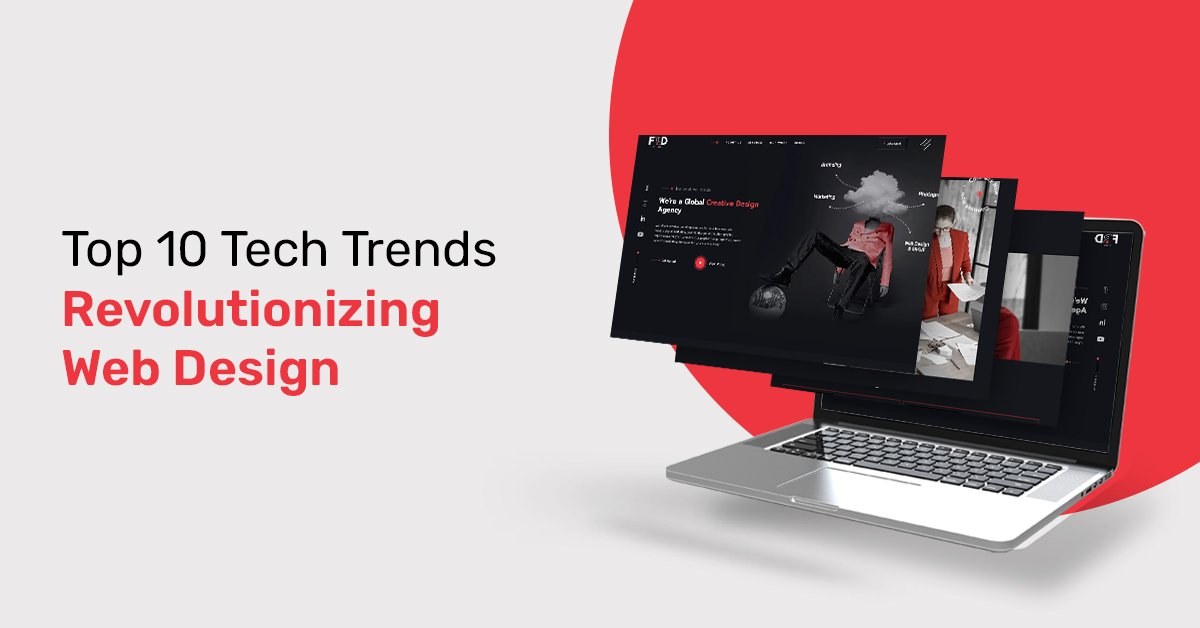
The following is a detailed blog covering the top 10 emerging technologies that will revolutionize the web design agencies in 2026. The current work incorporates the most recent knowledge and trends, and it will be relevant to the professionals of content who are concerned with digital marketing and web innovation.
Table of contents:
- Top 10 Technologies: Covers AI/automation, hyper-personalization, conversational UIs, 3D/AR/VR, sustainable design, WebAssembly, blockchain, quantum security, PWAs, and API-first/no-code platforms.
- Supporting Trends: Micro-animations, minimalist design, immersive storytelling, and non-traditional navigation.
- Strategic Adoption: Reasons for immediate embrace, including cost reduction and future-proofing.
- Conclusion: Leadership through technology integration
The year 2026 will mark a new or different wave of web design creativity, not just changing what aesthetically fits in the picture of design, but also the manner in which agencies develop, introduce, and operate digital experiences.
Those agencies, like FRD Studio, that take the early opportunity to facilitate these trends have the chance to establish themselves to make superior, quicker, and more engaging projects and place themselves in front of the unavoidable changes within the industry.
1. Artificial Intelligence (AI) and Automation
- AI is responsible for helping generate code that allows designers to instantaneously create functional prototypes via wireframes or sketches.
- AI-generated copywriting and visual generator tools significantly improve mockup timelines.
- Lastly, AI analytics is helping agencies to personalize and customize sites while users are live, adapting specific content and layouts for each person.
In addition to agencies acting quicker, AI has become essential to their marketer value propositions as a differentiation and competitive position, allowing them to deliver dynamic content personalization and predict UX improvements for the user that can boost the top design agency in Gurugram.
2. Hyper-Personalization and Dynamic UX:
- Real-time data will drive adaptive user web interfaces that change dynamically while users interact with the site, adapting to users’ preferences and prior practices.
- Predictive analytics will anticipate users’ needs to obtain, provide, and present valuable in-context resources throughout the user’s journey.
- This has been led by e-commerce and SaaS, along with marketing platforms, but hyper-personalization is now entering every sector, making agency-led experiences more interesting and conversion-optimal, which can increase the rank of the performance marketing agency in Gurugram.
3. Voice Experiences and Conversational User Interfaces:
- The concept behind voice experience and conversational user interfaces is that a user should speak into their phone to enable phone capabilities, applications, or information.
- Giving the customers on-demand support and product suggestions, and browsing the materials in a chat room or voice.
- The incorporation of conversational UI into such core processes as assistive support, onboarding, e-commerce funnels, etc., will increase engagement and reduce the burden.
- Popularizing voice search compatibility with accessibility needs and the preference for hands-free browsing by the user.
This will see agencies incorporate superior, visually branded conversational interfaces to achieve customer experience objectives of the clients in 2026, which can enhance the most trusted design agency in Gurugram.
4. Highly sophisticated 3D, Virtual Reality (VR), and Augmented Reality (AR) experiences:
VR and AR, the three-dimensional elements on the web, have now become not only an opportunity that they offer to web projects but also a mainstream opportunity, not only offered by giant-budget innovators. And with WebGL, Three.js, and AR toolkits, we are able to:
- In addition, virtual try-ons, virtual storytelling, and interactive product views are available online.
- Provide an AR overlay to provide an experience in their personal space (furniture, fashion, cars, etc.).
- Grow marketing tours with the help of virtual reality (real estate, traveling, entertainment): the physical and the web are combined.
- As the demands on consumers to be more interactive increase, the agencies that are already taking advantage of these tools are creating high-quality projects that attract and retain users and can make the web development agency in Gurugram.
5. Web Designing, Which Is Both Ethical and Sustainable:
Sustainability is becoming a wish and a necessity for agencies and their clients, in energy consumption and social responsibility. The new agency toolkit consists of:
- Creation of lightweight, high-speed web pages, which will not transmit unnecessary information and, therefore, will not consume unnecessary server energy.
- Ecologically friendly hosting and development practices, as well as a minimalist style design.
- Providing a designed accessibility that employs high-contrast colors, inclusive language, and screen-reader accessibility.
- Consumers are buying products according to environmental qualifications or moral standpoints. Sustainability solution agencies assist their clients in establishing trust and market share.
6. WebAssembly and the Web App of the Future:
- WebAssembly (Wasm) is unleashing a near-native performance of web applications and enables agencies to build outstanding and intricate websites that would have been previously possible only with the use of native applications.
- The web experience now includes real-time video and audio editing, making the video and graphics incredibly immersive, and even the heavy amount of computing is available in the web browser.
- WebAssembly enables agencies to develop cross-platform applications that would save time and money and reach a larger audience.
- WebAssembly is an unerasable component of the new era of Progressive Web Apps (PWAs), where they can be capable of performing a better set of functions while offline.
7. Decentralized Applications:
blockchain:
Not only cryptocurrencies but also web authentication, content monetization, and digital rights management (DRM) are becoming the new focus of blockchain technology:
- Agencies are working on blockchain to use safe logins and decentralized user identity.
- Smart contracts are appropriate in micropayments and workflows, which are opening up new monetization channels to content creators.
- Decentralized hosting will offer resiliency and censorship resistance, which is especially valuable in highly controlled industries and brands that care about their privacy.
This gives a chance to venture into niche markets amongst agencies.
8. Quantum Computing and Security:
Quantum Computing: The idea of quantum computing is quite familiar: it represents the term that indicates that a computer is a physical machine akin to the standard computing machine, yet uniquely possesses an additional quantum characteristic.
Agencies that initiate planning towards quantum-resilient security, though this is still nascent, will gain a great advantage in the future:
- Web authentication and data privacy, as well as transaction security, are being studied and tested using quantum-safe algorithms.
- Agencies are educating their clients about the wonderful risks—and opportunities—that await them with quantum advancements.
- Before the year 2026, chances are that you will not be working with quantum web applications the way they are currently, but agencies that start building their own digital experiences to be quantum-ready will be on the frontline.
9. Enhanced Mobile Solutions: Progressive Web Applications (PWAs):
PWAs develop a fair version of websites and mobile applications. According to agencies, websites are being developed to proxy apps by 2026:
- PWAs have offline capabilities, load instantly, and also have push notifications, which could only be viewed in native applications.
- Reactive, perhaps even device-responsive, design implies excellent experiences across all screens and OS.
- Service workers, advanced caching, and modular code will be used by agencies to create robust and maintainable multi-platform sites.
- “Mobile-first” has now evolved. Your agency will be left behind unless it constructs PWAs.
10. Emergency Ordinary: API-First, the Emergence of No-Code:
The concept of API-first and no-code/low-code is fully disrupting the very nature of website construction, using the actual purpose of an agency moving to being more strategic and user-focused than hand-coding before.
- Agencies can construct modular locations for all the services it incorporates—be it e-commerce or incorporating analytic services—then templates/apps will be shared to a normal API.
- No-code tools enable prototyping faster, have shorter feedback loops with clients, and can have greater speed-to-launch, all of which are important as competition mounts.
- The API-first approach will make the web interoperable and scalable, as it will decouple the front-end architecture from the back-end architecture.
The Trends that Support Agency Success:
Micro-animations and Significant Interactions.
Even minor features like animated icons and user-interactive elements help to provide a better user experience and contribute to the brand image of a site. Micro-animation attracts the user, draws the attention of the user, and enables quick communication of the message—all necessities in an age where attention spans are minimal.
Minimalism and Monochromatic Design.
Shifting the image to a space of visual austerity, monochrome color schemes, dark mode, and large typeface makes the brands stand out among each other, in addition to reducing the cognitive load on the user. The light load on the page and resource sharing and allocation are also enabled by minimalism, as well as sustainability and available best practices.
Storytelling, Immersive Content, and Video.
Agencies are also slightly rediscovering their immersive storytelling, new forms of interactive content, embedded video sharing, scroll-triggered animations, and illustrated content. Such kinds of content generate more dwell time, sharing, and backlinks potential through SEO, which makes films even more valuable to brands that are design-oriented.
Non-Traditional Navigation
The more recent forms of navigation, including horizontal scrolling, diagonal flows, large footers, and years of depth worth, help in creating new, memorable user experiences. A combination of old UX principles and creativity and uniqueness in application can assist the agencies in differentiating their clients’ websites from others.
The Portfolio of Web Design Agencies Is Advancing
Web design agencies are facing an increasingly competitive landscape. Clients are expecting more. The implementation of the ten new technologies will provide agencies, along with their project teams, with the most robust suite of tools to deliver superior outcomes that can be combined into core areas: performance, personalization, creativity, ethics, and scalability.
Advanced agencies will begin realizing the four potential benefits associated with the above ten new technologies:
- Lower cost and turnaround: Automation and low-code/no-code technology will eliminate bottlenecks and create efficiencies to allow us to create more.
- Quality of Differentiated Services: Leveraging immersive AR/VR technology, highly personalized AI-powered micro-interactions will provide clients with the differentiated experience that sets online experiences apart from others.
Future-proof client investments:
As agencies move towards sustainability (or support clients to cross that bridge), client investment can be sustained in the investment through sustainable design, quantum-safe architecture, and API-first development to extend access and opportunity beyond the design.
Conclusion
- The top 10 technologies outlined above are not simply trends; they are the building blocks of a new paradigm for web design agencies by 2026. The agencies that build expertise and invest in their onboarding now will lead the digital experiences of the next decade.
- The digital portfolio has never had more potent tools to aid outcomes, depending on AI control processes and highly personalized content generated by using math to quantum-safe infrastructure in the development of API.