



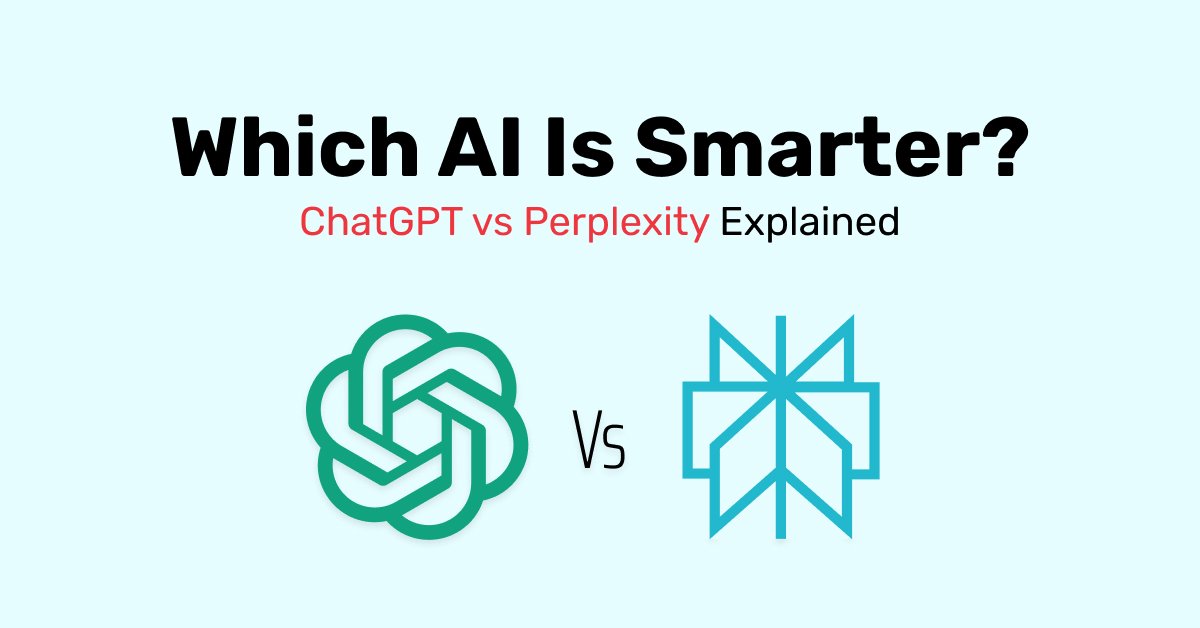
The mode of interaction between humans and technology is rapidly changing with AI, and the most frequent examples are conversational AI and research assistants. Two of the most prominent AI tools in the modern world are ChatGPT, using OpenAI and Perplexity AI.
Although both fall under the umbrella of conversational and language AI, the design philosophies, their capabilities and instances of best application differ significantly.
As the content maker, researcher or plain user trying to resolve on the right AI assistant, it is prudent to understand the differences that lie behind them.
Table of Contents
- Introduction to ChatGPT vs Perplexity AI
- Overview of the two AIs and their transformation of technology interactions.
- Core Definitions and Key Differences
- What each AI is, including a comparison table of features and functionalities.
- Intelligence Breakdown and Use Cases
- Defining “smartness,” conversation quality, real-time access, accuracy, and creative capabilities.
- Specialised Features, Pricing, and Accessibility: Unique modes, multi-lingual support, subscription plans, and target audiences.
- Final Verdict and Recommendations
- Which AI wins in specific scenarios, plus summary points for quick reference.
This blog explores the inner mechanics of ChatGPT and Perplexity AI and compares their pros and cons, as well as the ways in which each of them is a smart tool in its own right. At the conclusion, you will see a clear picture of what AI will be more fitting for your specific needs.
ChatGPT and Perplexity AI: What are they, and what do they do?
ChatGPT is the state-of-the-art model generated by OpenAI, and it is a generative language model, which is based on the GPT (Generative Pre-trained Transformer) architecture. It is also very useful in creating human-like text, holding consistent conversations across multiple turns, and solving a broad spectrum of creative writing and problem-solving and can boost the top design agency in Gurugram. The ChatGPT intelligence is presented in the form of natural language processing, contextual comprehension, and response generation to a broad range of questions.
Perplexity AI is also more of an AI-based search engine and research anthropomorph. It uses huge language models and integrates web search in real time to give brief and accurate answers with automatic citation. In contrast to ChatGPT, the very design of Perplexity is based on the correct retrieval of information and verification, as well as providing research-based answers instead of dialogue.
This breakdown represents the mind map of their respective fields—ChatGPT is a flexible conversationalist and creative multitasker, and Perplexity is a precision research tool that reports facts with up-to-date information.
Definition of Intelligence and Smartness.
The idea of smarter AI is very much dependent on a task that you would want the AI to solve, like FRD Studio is using.
The intelligence of ChatGPT is that it can comprehend complex and abstract questions and produce context-driven and natural text on any subject. It is strong in both logical thinking processes and creative language, code assistance, and maintaining human conversations.
The Intelligence of Perplexity has deep foundations in the capabilities of searching up-to-date and correct information and aiding research with heavily sourced answers. It is intelligent in cross-referencing credible data, referencing, and reducing false information.
Thus, “smarter” is relative and situational: ChatGPT is smarter when it comes to conversational intelligence in open-ended settings, and Perplexity is smarter when it comes to research accuracy and retrieving data in real-time and can improve the rank of the web development agency in Gurugram.
Specificity and coherence of dialogue.
ChatGPT is constructed in a manner that puts more emphasis on the development of the conversation. It has the capability of maintaining the conversational environment up to the extent that there are numerous conversations, and follow-up questioning or corrections are free-flowing. It best fits the use cases that are grounded on subtle ongoing interactions such as tutoring, customer support or creative idea brainstorming.
The perplexity is more transactional, but conversational. It will be oriented on offering a proper answer in the short term rather than sustaining a pleasant conversation. This can leave this interaction not so natural, but more efficient for users making direct queries on research.
Having information on the fly.
The other significant difference maker is that Perplexity has a live web search built in. Any questions are sifted through real-time web-based information, and the answers are provided with a reference to the source. This is invaluable in the news search, current studies or creating a topic.
ChatGPT has had a fixed cutoff date for the training data and delivered answers offline. New upgrades, however, allow optional web browsing, which is manually activated and is also not fully integrated into the easy integration of Perplexity.
That is why Perplexity AI will have an advantage over those users who need the most relevant, verifiable data and be able to increase the popularity of the most trusted design agency in Gurugram.
Precision, Consistency and Hallucinations.
The two AIs can generate false or hallucinated information, but their hallucinating patterns are different.
ChatGPT is a generative and creative artificial intelligence which occasionally generates credible and fake or unprovable text. This is more common on open or speculative questions.
The perplexity-reducing citation-based real-time methodology minimises the hallucinations since any answers are grounded on verifiable sources. It is more specific in testing academic or technical studies, as well as knowledge.
Confusion is, then, commonly sought in those situations where the accuracy of truth is of more importance than the ease of dialogue.
Creative and technological abilities.
ChatGPT is highly imaginative; it is able to create stories, essays, emails, poetry and code. The ability to deconstruct abstract, creatively suggestive prompts and generate undertones is not comparable with Perplexity.
ChatGPT can help developers build fast and clean UI code and other features, and debug a wide range of technical languages, and it can generate and support code generation.
On the other hand, perplexity is improved in logic-intensive descriptions of debugging and research, as well as the summarisation of complex information, but not the fluidity of creativity of ChatGPT and the expansiveness of code.
Professional Features and Modes.
Both sites offer special utilities to be used:
Perplexity AI also has Perplexity Deep Research Mode that cross-checks the sources, fact-checks other sources, and creates reports with many citations that can be used in research, both academic and professional.
ChatGPT also has the option of creating custom GPTs that are task-oriented with bot personality and advanced reasoning, as well as its capability to break down complex scenarios logically.
The tools have these features that enhance their core strengths; in other words, Perplexity is a research-accuracy tool, and ChatGPT is a facilitator-flexible and innovative tool, and can transform the performance marketing agency in Gurugram.
Multilingualism and Accessibility.
ChatGPT supports over 50 languages, and it provides natural-like yet cross-lingual communication between various individuals at the global level.
Perplexity stimulates fewer languages (estimated at 28) but accentuates the accuracy and references in the languages. This may also affect the readability among some users in the world who may desire a greater degree of flexibility in the usage of languages that are not comprehended by Perplexity.
Pricing and Availability
ChatGPT is rather widespread and has the free and paid Pro and Plus versions, distinguished by various speeds, prompt length, and additional features.
Perplexity comes with a free version that involves a live search, and a Pro subscription offers more features of analysis at a fee.
They are both web-based with web interfaces and APIs, which are more or less different in regard to being focused on research as opposed to conversational applications.
Who Should Use ChatGPT?
Authors, editors, and brainstormers are in need.
Coders in need of code generation and code debugging.
People who are willing to hire an interactive tutor, e.g., professionals and students.
Conversational bots that are interesting are wanted by the customer service.
Who had adaptive and multi-turn dialogues and an imaginative style.
Who Should Use Perplexity AI?
Researchers are seeking real-time and reliable information.
Those in need of detailed and citation-based information are scholars and policy researchers.
Writers of reports are required to be checked by multiple sources.
Users who want to have a fast research assistant to update them on what is happening.
Any individual who values accuracy and clarity of information more than naturalness in conversations.
Who Is Smarter, AI?
The underdog solution: They are both intelligent- but not in the same areas.
ChatGPT is more innovative, is capable of multiple natural conversations, has a wider understanding of language, and can write technical code.
Perplexity AI is smarter in real-time fact finding, research precision, open sourcing, and synthesising information in an academic manner.
The choice of the smarter AI is an objective issue. ChatGPT cannot be compared to creative or iterative discussions or code assistance. Perplexity is the superior one in the scenario of rigorous research and valid and recent facts.
The two tools that have been complementary to each other in most instances have been welcomed in the current AI environment. The creativeness of ChatGPT, like the accuracy of research of Perplexity, can be utilised to the utmost calibre of its users, provided that they are sufficiently productive and intelligent.
Summary points
- ChatGPT Chatbot with natural, creative multi-turn conversation and problem-solving.
- Perplexity AI: Science-based AI that provides fact-checked and citation-supported real-time answers.
- ChatGPT is very creative, codes, tutors, and engages with the user.
- Perplexity is excellent in precise research, validation of sources, and retrieval of current information.
- Neither AIs are necessarily smarter, and their capabilities are oriented to the needs and circumstances of different users.
Conclusion
This comparison is intended to give you the courage to select between these two powerful AIs, not by stating that one of them is better than the other, but by explaining that one is superior in one way. Both ChatGPT and Perplexity AI have a vision of the high standards of intelligent help in the future (2025 and beyond).